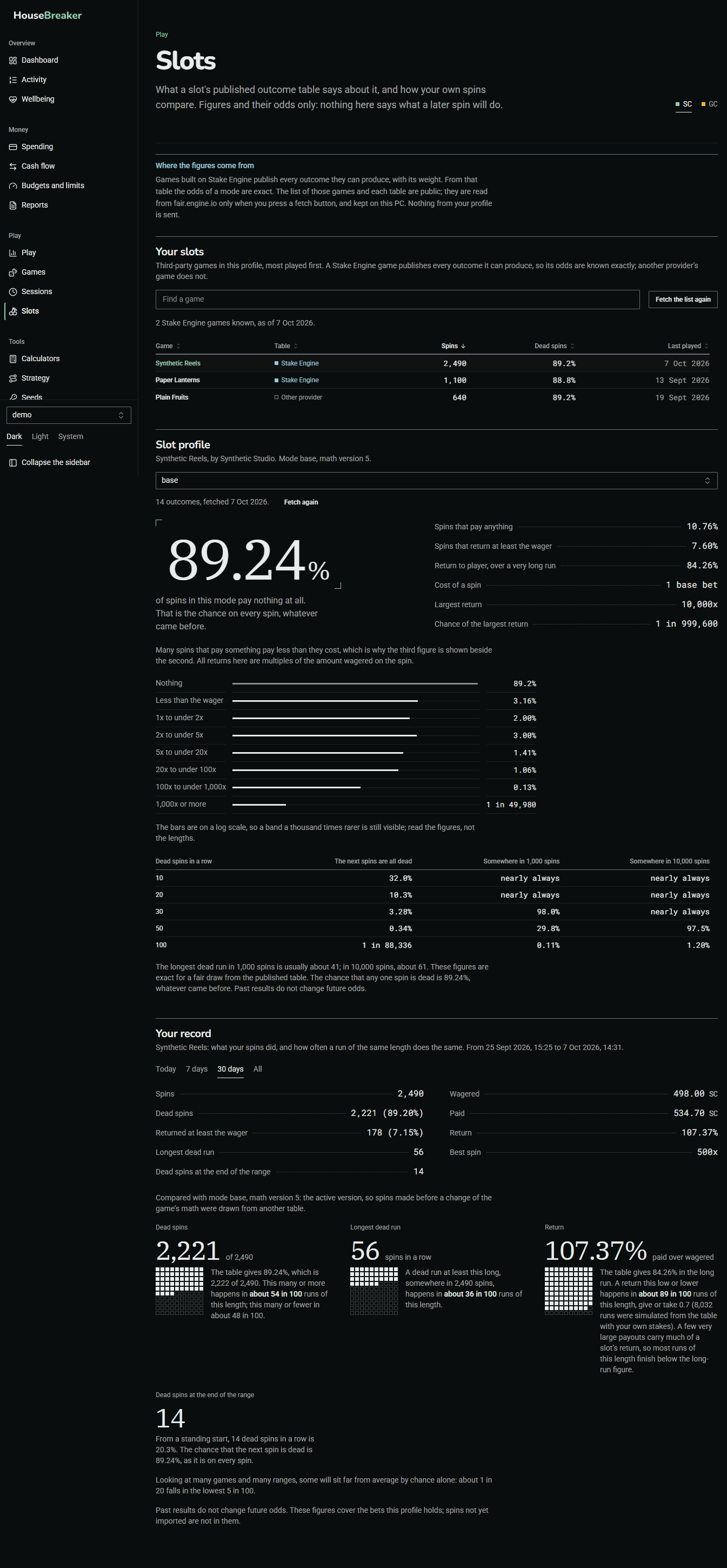
The Slots screen in the desktop app shows two things about a slot you have played: what its published outcome table says about it, and what your own spins did. It gives figures and how often they happen. It never says what a later spin will do, because nothing can.
What a Stake Engine slot is
You will see each of your slots marked Stake Engine or Other provider.
Many slots on Stake are built on Stake Engine. Those games publish every outcome they can produce, each with a weight that fixes how often it comes up. Because the whole list is public, the odds of such a game are known exactly, not estimated.
On stake.us you can tell them apart by the Fairness button under the game: on a Stake Engine slot it opens; on any other slot it is greyed out.
Other providers publish no such list. For their games HouseBreaker can show what your spins did, and nothing to compare it with.
Fetching the list and the tables
You will see a button, Fetch the list of Stake Engine games, the first time you open the screen.
- The list and the tables are public. They are read from
fair.engine.io, which is Stake Engine's own fairness service. - Nothing is fetched until you press a button. Nothing from your profile is sent: a table is asked for by the game's public name.
- A table is fetched once and kept on this PC. A mode's table is fixed, so it never needs fetching twice; Fetch again is there in case a file is damaged.
- A few modes have many millions of outcomes. Those are not fetched, and the screen says so.
If the PC is offline, everything already fetched keeps working.
Reading the slot profile
You will see a table of figures for one mode of the game. A mode is a way of playing it: the plain spin (usually called base), an ante, or a feature buy. Each mode has its own table, and the mode switch lists them.
| Figure | What it means |
|---|---|
| Dead spins | The chance that a spin pays nothing at all. |
| Spins that pay anything | The rest. Many of these pay less than the spin cost. |
| Spins that return at least the wager | The chance that a spin gives back what it cost or more. This is the figure to read beside the one above. |
| Return to player | What the mode pays back over a very long run, as a share of what is wagered. |
| Cost of a spin | How many base bets the mode costs. A feature buy may cost 100. |
| Largest return | The biggest result in the table, as a multiple of the wager, and how rare it is. |
Below that, the bands show the chance of each size of return on one spin. The bars are on a log scale so that rare bands can be seen at all: read the figures, not the lengths.
The dead runs table answers "how unusual is a long run of nothing?" For each length it gives the chance that the next spins are all dead, and the chance that such a run turns up somewhere in 1,000 or 10,000 spins. On a slot where nine spins in ten pay nothing, a run of thirty dead spins somewhere in a thousand is close to certain.
The profile is always the game's current math version. If the game's maker has changed its math, your older spins were drawn from an earlier table, and the screen says when a game has had more than one version.
Reading your record
You will see your own spins on the game for a range you choose: today, 7 days, 30 days or all. SC and GC are separate records and are never added together.
The first block is simply what happened: spins, dead spins, spins that returned at least the wager, the longest dead run, the dead spins at the end of the range, what you wagered and were paid, and your best spin.
For a Stake Engine slot, three figures are then set against the table. Each is put as "happens in about X in 100 runs of this length":
- Dead spins. How often a run of this many spins has this many dead ones or more.
- Longest dead run. How often a run this long has a dead run at least as long as yours somewhere in it.
- Return. How often a run of this length, at your own stakes, returns as little as yours or less. This one is worked out by simulating thousands of runs from the table, so it comes with a "give or take".
A figure near 50 in 100 is an ordinary run. A figure of 2 in 100 is an uncommon one. Neither is a statement about the slot.
Two things make these figures easy to misread, and the screen says both:
- Most runs finish below the long-run return. A few very large payouts carry much of a slot's return. A run without one of them sits below the published figure, and that is the usual case, not a sign of anything.
- Look at enough games and some will look extreme. About 1 in 20 runs falls in the lowest 5 in 100 by chance alone. If you check twenty games, expect one of them to.
When no comparison is shown
You will see your figures without a comparison, and one sentence saying why, in these cases:
- Too few spins. Below 200 spins in the range, the answer would mean nothing.
- The spins do not fit the mode. If many of your paying spins returned amounts the mode's table cannot produce, they were played in another mode, such as an ante. Choose that mode under Slot profile. HouseBreaker cannot always tell which mode a spin was played in, because your bet history does not record it.
- Feature buys. Spins with a stake far above the ones around them are set aside as feature buys and counted separately, because they are drawn from a different table.
- The table has not been fetched, or the mode is too large to fetch.
- Another provider's game. There is no table.
What the figures do not tell you
- Nothing about the next spin. The chance that any one spin is dead is the same on every spin, whatever came before. A long dead run does not make a win more likely, and a good run does not make one less likely. Past results do not change future odds.
- Nothing about whether to keep playing a slot. A slot that has paid you nothing for an hour has the same odds it had when you sat down.
- Nothing about spins you have not imported. The record covers the bets this profile holds. Slot spins reach it through your Game Archive files; spins made since the last import are not in it.
- Nothing exact about other providers' slots.
The same from the command line
hb slots catalogue --refresh
hb slots profile "<game>" [--mode <mode>]
hb slots record "<game>" [--currency sweeps] [--from 2026-09-01] [--to 2026-09-30]
<game> is the game's name as your bets show it. hb slots profile fetches the mode's table the first time it is asked for.